A construction site with employees applying paints or coatings needs washing facilities under OSHA 1926.51(f)(1), and general jobsites still need adequate potable water under OSHA 1926.51(a)(1), plus toilet facilities sized to crew count under 1926.51(c). Riverview Porta Pros sets up stations with soap and towels, since sanitizer alone does not meet 29 CFR 1910.141(d)(2).
The rule people misquote most is 1926.51(f)(1). It does not apply to every jobsite in Riverview. It kicks in specifically where employees are applying paints, coatings, herbicides or insecticides, or working around other harmful contaminants. If that is not your crew, you are not automatically exempt from sanitation duties, but you are not under that specific washing-facility trigger either, since general sanitation and toilet counts fall under 1926.51(c) instead. Separately, 1926.51(a)[1] requires an adequate supply of potable water at any place of employment, painting or not. And once you do put washing facilities on site, 29 CFR 1910.141(d)(2) sets the bar: soap plus towels or a hand-drying device. Hand sanitizer stations are a fine add-on, but they do not satisfy that rule on their own. If you are pairing washroom facilities with toilets, check OSHA portable toilet requirements for the toilet-side ratios under 1926.51(c). For a full sanitation walkthrough before you order anything, the handwashing station rental page covers unit types side by side.
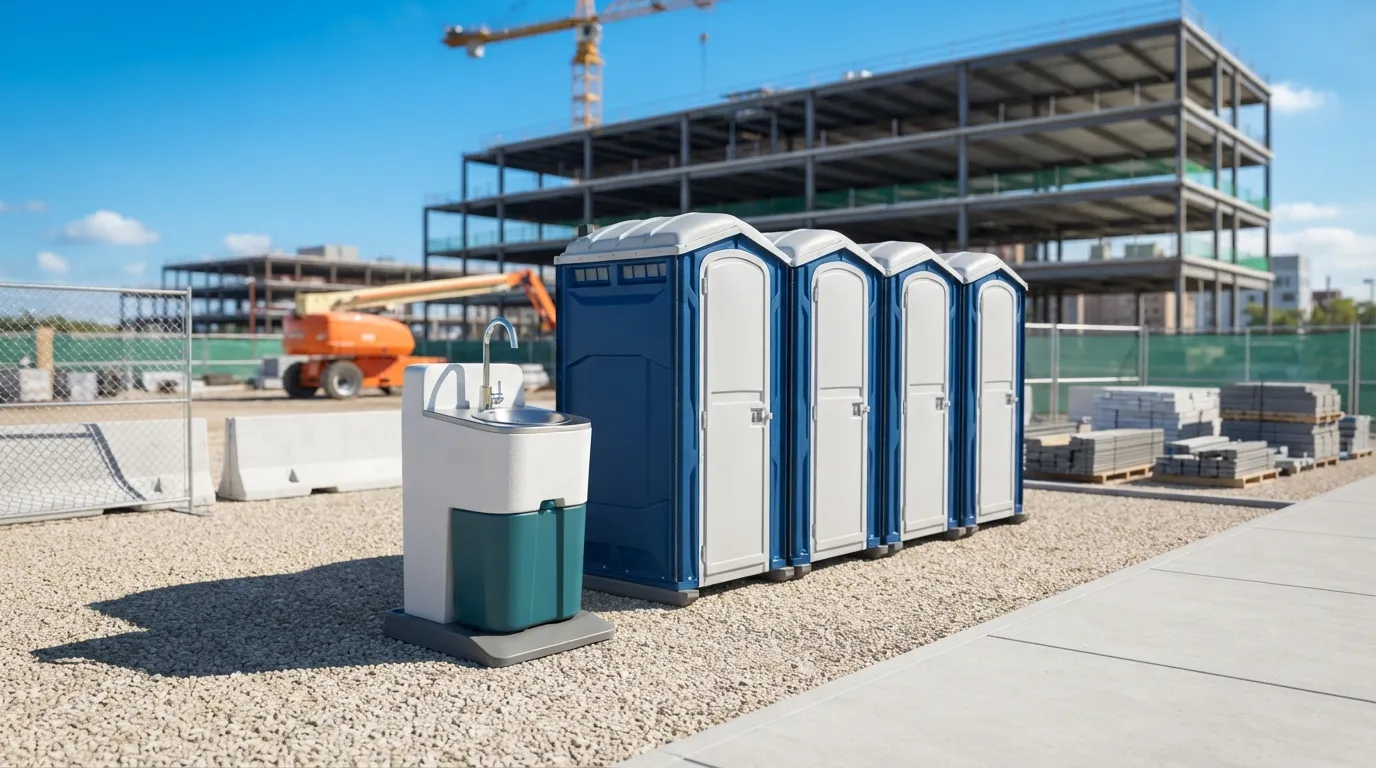
Yes, in scenarios involving paints, coatings or similar contaminants, because a toilet unit and a handwashing unit satisfy different rules. A portable restroom rental covers 1926.51(c) toilet counts. A separate sink covers the washing-facility requirement once paints, coatings or similar contaminants are in play. Farms hiring hand-labor crews fall under a different standard entirely: OSHA 1928.110 requires potable water, toilets, and handwashing within a quarter mile walk, at one facility per 20 employees, which matters for anyone running farm and agricultural restrooms work near Balm, 6.6 miles south of Riverview. Event organizers ask this too. A wedding at a venue outside town or a festival near Bloomingdale, 7.1 miles northeast, still benefits from a stand-alone sink bank next to the event restroom rental units, since guests wash up faster at a dedicated station than waiting on a toilet line. Pair stations with a portable sink rental if you want plumbed-feel units instead of basic troughs.
Put them next to the toilets, and close to the work when contaminants are involved. ADA Standards section 403.5.1 calls for 36 inches of clear route width getting to the unit, and section 302.1 requires the ground under it to be stable, firm and slip resistant, which matters on the sandy or graded lots common around Riverview job sites. If a wheelchair user needs to reach the pump or soap dispenser, section 308.2.1 sets the reach range at 48 inches high and 15 inches low, and section 309.4 requires operable parts to work with one hand and no more than 5 pounds of force. None of that is optional dressing. It is the same standard referenced on ADA restroom requirements and it applies to companion handwashing units the same way it applies to the ADA accessible porta potty itself. Placement also has to account for daily servicing access; see the porta potty placement guide for the delivery clearance logic that applies to sinks too.
Generally yes, and food handling raises the stakes further. Anywhere food is prepped or served, from a county fair restrooms setup to a film set restroom rental craft services tent, a working sink with soap and towels belongs near the food line, not just near the toilets. Restaurants and catering operations also generate grease that needs separate handling. That is a different system: a grease interceptor gets pumped once fats, oils, grease and solids reach 25 percent of the liquid depth, which is a grease trap pumping issue, not a handwashing one, but the two often get scheduled together on the same service call. For race-day crowds, a marathon and race restrooms layout usually puts one sink bank per toilet cluster so runners are not backtracking across the course. Golf events follow the same logic; see golf tournament restrooms for cluster spacing. If you are still scoping numbers, how many porta potties do I need walks through headcount math that applies to sink counts too.
No. Under 29 CFR 1910.141(d)(2), a compliant washing facility needs soap and towels or a hand-drying device. A hand sanitizer station rental is a good supplement between services, but it does not replace a sink where the rule requires one, especially on jobsites where employees apply paints, coatings, herbicides or insecticides under 1926.51(f)(1).
It scales with headcount and layout, not a flat number. ANSI/PSAI Z4.3 sets a baseline service interval of once weekly for up to 10 users over a 40 hour week, and that ratio is a reasonable starting point for sizing units before you talk to Riverview Porta Pros about your specific crew.
Yes, where units are clustered. ADA Standards section 213.2 requires at least 5 percent of clustered single-user units to be accessible, never fewer than one. That applies whether you are running a wedding, a festival restroom rental footprint, or a concert near Fish Hawk, 9.7 miles east.
Yes. Standalone sink rentals are common at food booths, film sets and grease-heavy kitchens. Check portable sink rental for unit options, and pair it with septic pumping service if the site also needs holding tank support.
Mostly plumbing detail and finish level. Both meet 1910.141(d)(2) if stocked with soap and towels. A portable sink rental unit often has a nicer basin and foot pump; a basic handwashing station is built for high-traffic jobsite use near Gibsonton, 6.8 miles west.
Yes. Riverview Porta Pros delivers handwashing station requirements across Riverview and the surrounding metro, with same-day and next-day drop-off available on most orders.
Pricing depends on the unit and how long you need it. See our cost breakdown and request a free quote for an exact figure.
Standard rentals include scheduled service — a pump-out, a clean, a restock and fresh deodorizer. Busy or hot-weather sites can be serviced more often.
Call now or request a free quote — clean units, on-time delivery, transparent pricing.